Fun Facts about the Faculty: The Bartholin Complex
The newly renovated Bartholin Building received the City Architect’s Special Award in October. We already knew the building was beautiful, high-tech, and thoroughly modern. But did you know that…

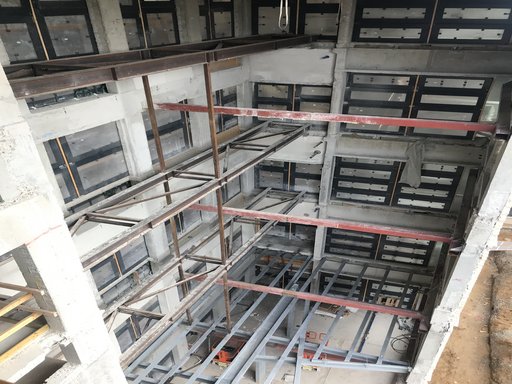
- … creating the atrium with a glass facade in the middle of the building is one of the most complicated renovation tasks ever carried out by Denmark’s largest contractors? It caused quite a few headaches for the construction company Enemærke & Petersen and for the demolition firm Kingo when they had to bring the architects’ drawings to life. How do you tear down the central part of an entire building and replace it with an atrium featuring windows from basement to attic – without the whole thing collapsing? The solution was temporary bracing – and a lot of it – which held the entire building together until the steel structures were slowly but surely built up from the ground.
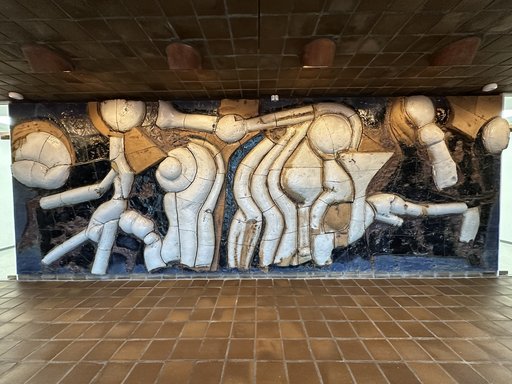
- … the ceramic relief in the entrance hall was baked in France because, in the early 1970s, no kilns in Denmark were large enough to bake pieces of ceramic that size? Professor Aksel Stenderup (1919-2001) was a visionary strategist and a major figure in bacteriology. He built up the former Institute of Medical Microbiology and Immunology and managed to have the Bartholin Building constructed in 1974, already then housing the most advanced research equipment. Stenderup also loved art. That is why the entrance area was decorated with such a large artwork that it covers the entire wall. The relief, rendered in the era’s characteristic colors, depicts fungal hyphae and was created by artist Allan Schmidt. Schmidt found inspiration for the motif after visiting Stenderup’s laboratory, where he observed the tiny structures under the microscope.
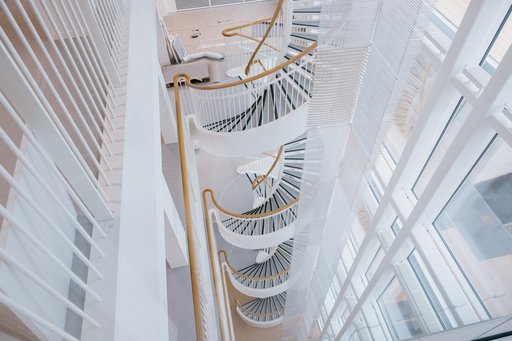
- … before the renovation, the building had an unusual floor structure – almost a double deck – allowing you to walk beneath the floor, slightly hunched, with the feeling of being in the building’s hidden engine room? The lower deck was removed during remodeling, but this was not straightforward: much of the building’s load-bearing structure disappeared along with it. A new floor construction was therefore developed using reinforced carbon fiber; a technology that gives the concrete a strength profile otherwise known from a well-built sports car: impressive tensile strength, low weight, and not a hint of corrosion. In this way, the load-bearing function could be recreated with a slim but powerful backbone, without adding mass or losing height. No wonder the Bartholin renovation took so long…
This text is based on machine translation