New chair aims to bring work on equal opportunities closer to everyday life
Siri Beier Jensen is the new chair of the faculty’s Committee for Diversity, Inclusion and Equal Opportunities. She wants to strengthen the work at department level, focus on leadership and help create a culture in which more people can thrive.

Siri Beier Jensen accepted the role because it matters. It is, really, as simple as that.
Since April, she has been the new chair of the faculty’s Committee for Diversity, Inclusion and Equal Opportunities. She takes over from Dean Anne-Mette Hvas, who has chaired the committee since it was established in 2022.
With the change, the chairing role moves closer to the departments. And for Siri Beier Jensen, who is head of the Department of Dentistry and Oral Health, that is an important point.
The work should not only live in strategies and meeting forums. It should be felt in everyday life at the departments, in research groups, in the administration, in meetings and in the decisions that shape the faculty as a workplace.
“I see this as a very important leadership task. On a par with responsibility for finances, employees, recruitment and academic development. This is not something we do on the side of everything else. It is part of our core task,” says Siri Beier Jensen.
It is about much more than gender
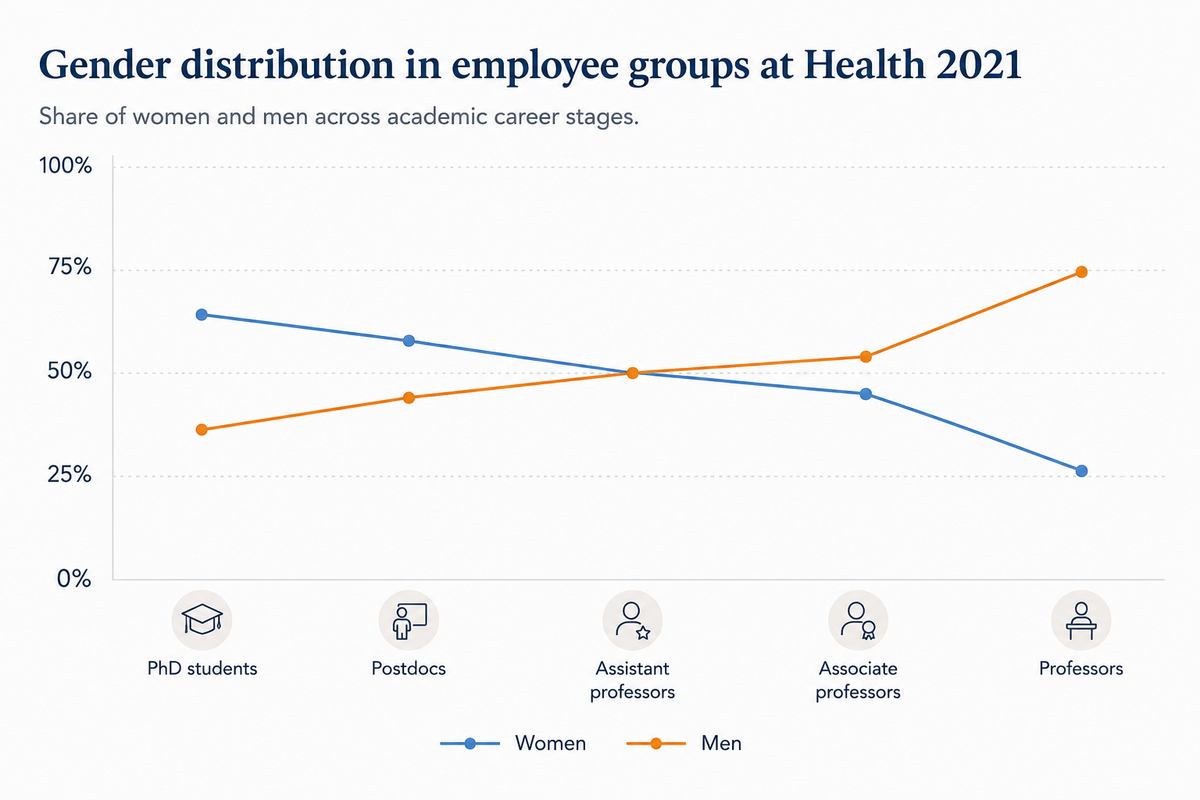
When the committee was established in 2022, the starting point was a clear problem: Women made up around 65 per cent of the PhD students at the faculty, but held less than 25 per cent of the professorships. The work therefore began with a clear focus on gender, career paths and more equal opportunities in the research environments.
The faculty’s Committee for Diversity, Inclusion and Equal Opportunities
Chair
- Siri Beier Jensen, Head of Department
Members
- Ask Vest Christiansen, Professor, Department of Public Health
- Marta Díaz del Castillo, Assistant Professor, Department of Forensic Medicine
- Julie Glavind, Clinical Associate Professor, Department of Clinical Medicine
- Peter Lindberg Nejsum, Professor, Department of Clinical Medicine
- Ruben Pauwels, Associate Professor, Department of Dentistry and Oral Health
- Dorte Rytter, Associate Professor, Department of Public Health
- Christian Bjerggaard Vægter, Associate Professor, Department of Biomedicine
- Jeannette Madsen, Management Consultant, Department of Biomedicine
Studenterrepræsentanter
- Lotte Eriksen
- Elizabeth Schirrmann Nygaard
Sekretær og kontaktperson
- Hanne Johansen, Adviser, Faculty Secretariat
Observatør
- Simon Fischel, Health Communication
The committee has worked on recruitment, career development, inclusive leadership and workplace culture. It has helped change practices in the use of search committees and mentoring schemes, created greater transparency around career paths and highlighted role models for younger researchers. The committee has also carried out so-called inclusion audits, in which the departments take a closer look at how tasks, resources and opportunities are distributed among academic staff.
Since then, the perspective has broadened. Today, the committee works with diversity, inclusion and equal opportunities for students, academic staff, technical and administrative staff, and managers.
Plenty of initiatives in the pipeline
Siri Beier Jensen points to employees’ different life stages as an important theme for the committee to work with in the coming years.
This may concern starting a family, parental leave and the early years of a research career, but also illness, grief and senior working life.
“There are structural issues we need to look at. How do we ensure conditions that genuinely provide equal opportunities? And how do we, as a workplace, accommodate the periods when working life may be affected by things other than work?” she says.
Another focus area will be technical and administrative staff. Here, the new chair sees a need to bring career and development opportunities more clearly into the conversation about diversity and equal opportunities.
“We have worked a great deal with the academic environments. Now we also need to bring administrative staff more clearly into the conversation. How do we create attractive career and development opportunities? And how do we equip managers to work with diversity, inclusion and equal opportunities in this area?” she says.
A culture where people dare to speak up
Siri Beier Jensen is not new to the area. She was a member of AU’s Committee for Diversity and Gender Equality from 2019 to 2025 and has also previously served on the faculty committee for several years. She therefore knows the history, the ambitions and the difficult discussions.
“There is momentum now, and we have a really strong committee. That is hugely important, because it is the members’ experiences, thoughts and everyday concerns that must help drive the work forward,” she says.
At its core, the new chair sees the work as a question of opportunities.
“When people have something to contribute, it should be brought into play. As managers, our job is to ensure that everyone has the opportunity to unfold their potential. If someone can and wants to contribute, but does not have equal opportunities, that is a problem we need to take seriously,” she says.
She makes no secret of the fact that major challenges remain. But she also sees clear progress. The conversation about diversity, inclusion and equal opportunities has become more open, and more people dare to point out where culture, structures or habits are getting in the way.
The faculty should meet this with curiosity, she believes.
“If someone experiences that they do not have the same opportunities as their peers, we need to listen. We need to see it as a chance to become wiser and dare to ask: Is there something to this, and what can we do to change it?”
The goal is not to find fault. The goal is to create better workplaces, ensure strong academic environments and provide the best possible conditions for everyone to contribute.
“If people do not feel seen and heard, they will look elsewhere. Then we lose talent. The work on diversity, inclusion and equal opportunities is important to ensure that we have good employees, and that good employees feel they belong at our workplace,” says Siri Beier Jensen.
Managers must take responsibility
For Siri Beier Jensen, there is no doubt.
If the faculty is to succeed in creating more inclusive environments and more equal opportunities, it requires managers who take responsibility for the task. Not only the dean’s office and heads of department, but managers at all levels: research leaders, functional managers, programme directors, group leaders and others with responsibility for people and working environments.
“First and foremost, as a manager, you have to acknowledge that this matters. If you do not, it can be felt throughout the organisation. You have to mean it and take responsibility,” she says.
At the same time, she emphasises that managers also need to be equipped for the task. Because the work is complex. It is about structures, culture, bias, life stages, career paths and much more that is not always visible to the naked eye. And it is about creating environments where difference becomes a strength, not an obstacle. If we succeed, it actually raises the quality of the work we can do as a team.
“Leadership plays a completely central role in bringing diversity into play so that it actually strengthens what we do. When we can challenge each other constructively through different perspectives, we also solve our tasks better,” says Siri Beier Jensen.
Contact
Advisor Hanne Johansen
The Faculty Secretariat, Health Administrative Centre
Mail: hannejohansen@au.dk
Telephone: 41 89 30 67