Mice from space help researchers understand muscle weakening
Researchers can order tissue or organs from mice that have scurried around on the International Space Station (ISS). A package containing pieces of space-mice has just arrived at the Department of Biomedicine.
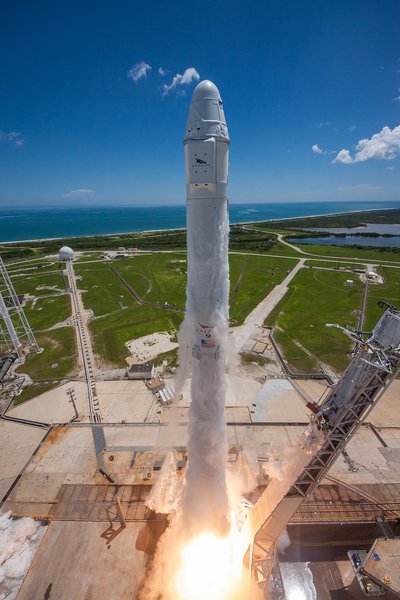
When NASA launches a SpaceX rocket from Cape Canaveral in Florida, there are usually about 40 mice on board.
Some 400 kilometers out in space, the small rodents are brought aboard the International Space Station – and there they undergo dramatic changes in their bodies.
Their bones weaken, their muscles shrink, blood circulation changes, and the immune system behaves completely differently from how it does on Earth.
For researchers, the mice represent a unique opportunity to answer questions that are difficult to address on Earth.
Weightless research
• Rodents have traveled in space since the 1950s.
• NASA, the U.S. national space agency, has developed a so-called Rodent Research Program through the Center for the Advancement of Science in Space (CASIS).
• The program makes it possible for researchers to collaborate with NASA on a wide variety of experiments conducted in a laboratory on the International Space Station (ISS).
• Researchers can also request, for example, tissue samples from rodents that have returned from a stay on the space station.
• Read more: https://issnationallab.org/
Picked up by a naval vessel
Researchers from around the world can apply for access to tissue or cells from the highly sought-after space-mice, which return home after 30–40 days with a splashdown in the Pacific Ocean.
In the autumn of 2025, a package containing tissue samples from returning space-mice arrived at Associate Professor Antoine de Morree’s laboratory at the Department of Biomedicine.
Before that, the space capsule had been retrieved by the U.S. Navy. The mice had been dissected by a NASA researcher in a laboratory in San Diego, and the samples preserved in ethanol.
“It’s a great recognition that NASA supports our research idea. But the logistics are a challenge. The capsules can be delayed, storms rage across the Pacific, and the military vessels provide only sparse updates on arrival times. The samples can get lost in transit, and the paperwork is a discipline of its own,” he says.
Why do some muscles weaken – while others don’t?
Antoine de Morree’s laboratory aims to investigate why the muscles of the mice’s diaphragm do not gradually weaken in space, even though their other muscles weaken.
“In previous work, we’ve found that stem cells in the diaphragm of space-mice behave differently from stem cells in other muscles. We want to test an idea that these stem cells have been particularly affected by cosmic radiation. This challenges our understanding of how muscles repair themselves,” the researcher says.
“Perhaps we have overlooked or misunderstood some of the body’s mechanisms simply because we have always studied them under Earth’s gravity.”
Antoine de Morree has previously been present at the dissection of mice returning from space. Other researchers from the Department of Biomedicine also plan collaborations with NASA.
Contact
Associate Professor Antoine de Morree
Aarhus University, Department of Biomedicin
Phone: 60 79 07 22
Mail: demorree@biomed.au.dk